


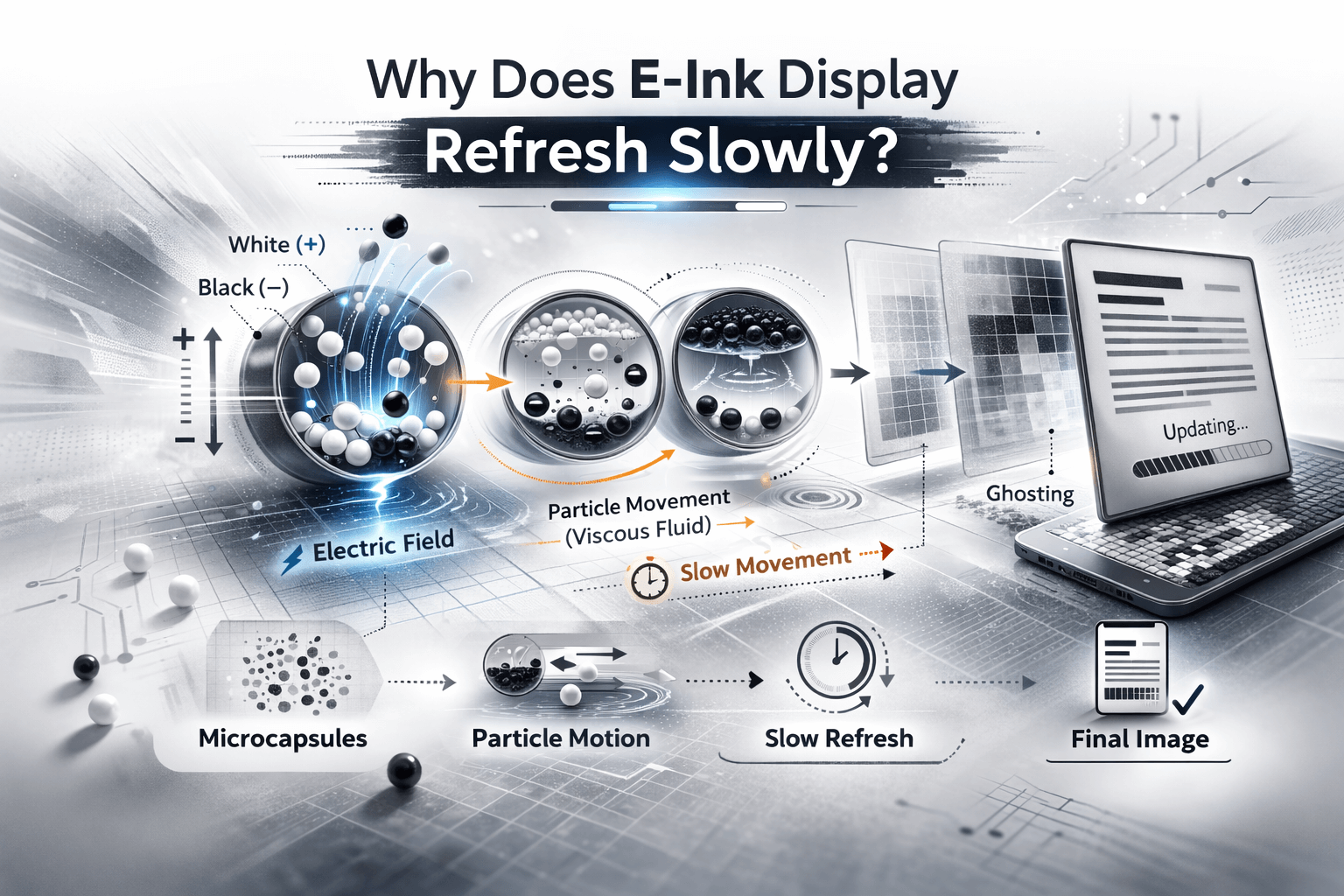
E-ink or E-paper displays are widely used in e-readers, digital signage and digital art frames. They offer ultra-low power consumption, and are easily readable in direct sunlight.
Its key features and benefits include:
- Low Power Consumption
- Paper-Like Appearance and Eye-Friendly Reading
- Flexibility and Versatility
However, one of the main primary weaknesses of e-ink displays is its slow refresh rate. Compared to LCD or OLED, e-ink displays normally cannot display videos.
Why does E-ink refresh so slowly? Because E‑ink displays form images by physically moving real micro‑particles suspended in liquid, rather than lighting up pixels with electric current like LCD or OLED panels.
| Display Type | Light Source | Display Mechanism | Refresh Speed |
| LCD | Backlight + liquid crystal rotation | Molecular orientation change | Milliseconds |
| OLED | Self‑emissive | Electronic transition | Microseconds |
| E-ink | Reflective | Physical particle movement | 100 ms to seconds |
Table 1. Refresh Speed of Different Display Types
Take the simplest black‑and‑white e‑ink display as an example. Its working principle is as follows:
Each pixel contains many microcapsules filled with:
- Positively charged white particles
- Negatively charged black particles

https://www.eink.com/
By applying an electric field, white particles are pulled to the top → the pixel appears white; black particles are pulled to the top → the pixel appears black.
The key point is that this is mechanical displacement, not electronic transition. These particles are microns in size and move within a high‑viscosity fluid, so their speed is far slower than electrons moving through a conductor. If the particles move too quickly, they may not settle accurately, causing artifacts or ghosting.
Refreshing an e‑ink display is not a simple on/off action. It involves multiple steps:
- Clearing the screen
- Reverse driving
- Multiple pull‑backs and fine adjustments
Each step requires waiting for the particles to stabilize. This is why you see the screen flash and gradually become clear during a refresh.
E‑ink is designed to be bi‑stable, meaning it can retain an image for long periods without power, with a paper‑like stable appearance. Achieving this requires sacrificing some refresh speed in exchange for ultra‑low power consumption and reduced eye strain.
With ongoing improvements, modern e‑ink displays can increase refresh speed through several optimizations:
- Black‑and‑white 1‑bit Mode
Fast‑refresh modes often support only pure black and white, removing the complexity of 16‑level grayscale calculations. The image is simplified to 1‑bit data, enabling extremely fast processing.
- Partial Refresh / A2 Mode
A full refresh cycles through black‑white‑black transitions to eliminate ghosting. Fast modes update only the pixels that change, without forcing a full‑screen wipe, greatly reducing update time.
- Dithering Algorithms
Techniques like Floyd–Steinberg dithering simulate gray levels using patterns of black and white pixels. This preserves acceptable image quality while maximizing refresh speed.
These techniques improve speed, but image quality decreases and ghosting accumulate more quickly.
Why Is Color E‑Ink Even Slower?
Because color e‑ink adds additional layers of complexity on top of an already slow black‑and‑white system. Each color technology introduces extra steps that slow down refresh.
Current mainstream color e‑ink technologies (Kaleido, Gallery) do not emit RGB light directly. Instead, they rely on layered structures or multi‑particle systems.
A. Color Filter Array (Kaleido)
This is the most common color e‑ink today.

https://www.eink.com/
Each color pixel is composed of multiple black‑and‑white sub‑pixels. A single-color pixel contains 3–4 monochrome sub‑pixels, and color depth is controlled by adjusting the black/white ratio. Changing a color cannot be achieved in a single drive cycle. To achieve fine grayscale control, multiple waveform adjustments are required, which increases refresh time.
Because this technology still relies on black‑and‑white particle movement, it can approach the speed of monochrome e‑ink, but color saturation is limited.
B. Multi‑Color Particles (Gallery / ACeP)
This is true full‑color e‑ink.

https://www.eink.com/
Each microcapsule contains four types of charged color particles (yellow, cyan, magenta, reflective white). Compared with controlling two particle types in monochrome e‑ink, this system must control four, greatly increasing complexity.
To display a specific color, each particle type must be positioned at the correct height. During refresh, the system must use extremely complex voltage waveforms to guide specific particles through a crowded mixture and bring them to the top. It’s like trying to push only the people wearing blue shirts to the front of a packed crowd—much harder than having everyone move together.
Particles collide and rub against each other during movement, and the internal electric field becomes more chaotic as particle types increase. To ensure accurate color without ghosting, the system must “shake” the particles repeatedly to settle them properly. This is why color e‑ink often flashes many times during refresh. A single refresh may require dozens or even hundreds of waveform cycles, taking several seconds or even more than ten seconds.
This technology produces vivid, saturated colors, but is too slow for interactive use.
Additionally, e‑ink is extremely temperature‑sensitive. At low temperatures, the liquid becomes more viscous, slowing particle movement further and requiring more complex compensation algorithms.
How Color E‑Ink Refresh Speed Can Be Improved
Current optimization efforts focus on hardware, software, and algorithmic improvements:
-
Hardware: Dedicated Display Memory and GPU
Traditional e‑readers rely on the CPU for image processing, but color e‑ink waveform control is too complex. Some manufacturers add a dedicated display processor to handle image conversion and waveform generation, reducing CPU load and improving refresh speed.
-
Software: Dynamic Refresh Modes
Manufacturers offer preset modes such as Fast or A2 Mode. These reduce color depth and resolution (using dithering) to increase speed. Page turns become very fast, and even cursor movement becomes visible, but noise and ghosting increase.
-
Algorithms: Waveform Optimization
Shortening voltage pulses allows particles to stop before reaching their “final” position, enabling quicker transitions.
Conclusion
Given current technology, e‑ink’s core strengths remain long‑term static display, low power consumption, and high readability. It cannot yet match TFT‑based displays in color vibrancy or interactive speed.
Should you have any questions, please consult our engineering.
Shop our E-Ink Display here: https://www.orientdisplay.com/e-paper/